Leadership Development | Antioch School

Building a Leadership Team to Reach Our City

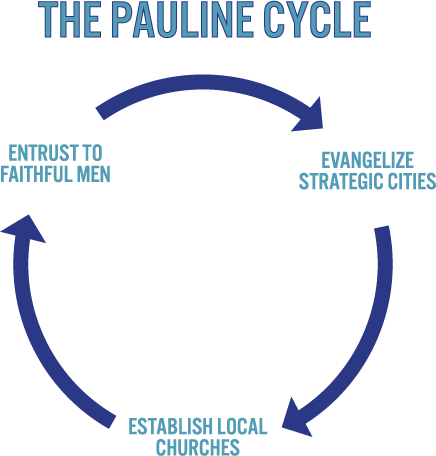
What is the work of a missionary? Depending on who is asking me the question, the answer can vary, but the essence is always the same. Training leaders who will establish the church is the work of a missionary and building a leadership team is a core aspect of our work in expanding the gospel to our cities. This is the model that is left for us, explained in the book of Acts. Paul and his team would share the good news in a city, gather those who responded into a church, and then appoint and train leaders to lead those churches. Recognizing this pattern, our ministry team at BILD International, is working with church-planting networks from all over the world. We are also doing this in Des Moines, Iowa, our home city. We are passionate about Des Moines, and we hope that all churches share this passion for reaching their home city.
Pauline Cycle_Blog - 1

About Des Moines, Iowa

Let me share some perspective from our journey in Des Moines and the practical aspects of implementing long-term habits. Here are a few factors that make Des Moines a strategic city for the expansion of the gospel:

      • Capital of Iowa
      • Home to over 551,000 residents
      • 780,000 people live within 60 minutes (=24% of Iowa’s population)
      • The greater Des Moines area is composed of 16 cities
      • Downtown and East Des Moines are the highest density, low-income zones of the city
      • Des Moines is a central hub and there are significant opportunities for “Seek the Welfare” initiatives.
2

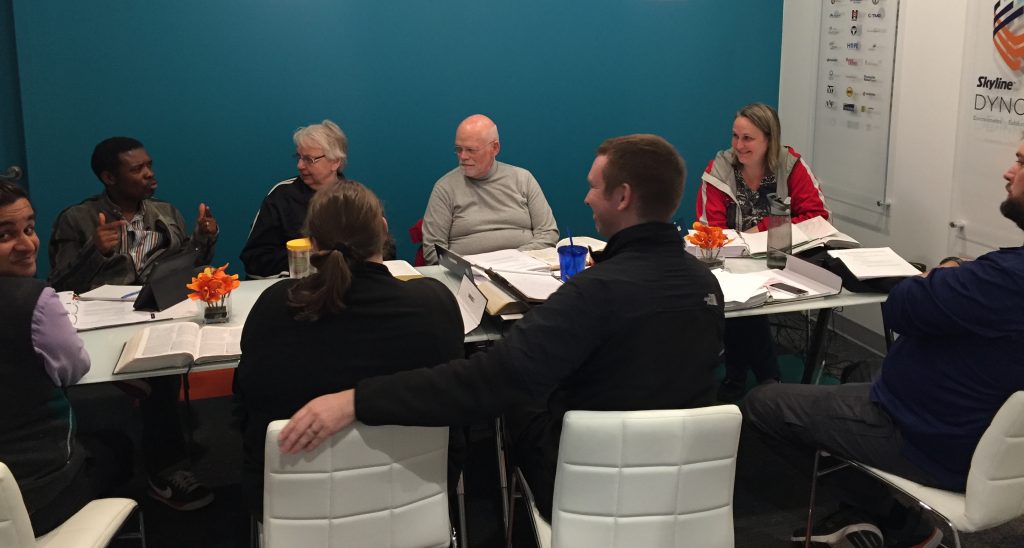
Leaders from different churches discussing the expansion and establishment of the church in Acts.

Encouragement From Our Journey

Leaders ask me how their denomination or network of churches can get people established in the faith, while often citing their unique circumstances, challenges and history of using a plethora of church programs. My initial response is: “We use Thursday evenings.” This is surprising to many leaders who are usually looking for another “plug and play” programmatic piece designed for today’s modern church machinery. But this cannot be the starting point. As leaders, if we understand our role in equipping the saints so that our people know the full counsel of God, we must help our people implement long-term habits for growing and developing in their faith.

Our leaders have been meeting on Thursday evenings for 10 years. This habit began when we were initially implementing the Antioch School because Thursday evenings worked best for everyone. When we started, we only intended to meet until we completed our Antioch School degrees. However, as the months passed by, we began to understand the principles for being a New Testament church, and realized that completing our degrees in the context of our church was just the beginning of our development.
5

During those years of meeting and learning these principles together, we started bringing food to share and slowly became a family that relied on each other. We shared our lives as marriages, occupations, pain and death were always part of someone’s life. In these initial years, our establishment and leadership development was housed and included a single church. After three years together, this church sent us out as church planters to our city, to continue the work to which we had been called.

This habit of meeting together regularly to establish each other in the faith, and be a family that encourages one another still continues today. Now, we have five different churches and we are seeing how each church plays a needed role in our city. Just as individuals are unique and have a role, the same is true for churches; each one is unique and has a role in the city. This ministry is only possible through the one-mindedness that is built through regularly studying and discussing the Bible together.

How It All Happens

We meet in a business owned by one of our benefactors. Our Thursday evenings looks like the following:

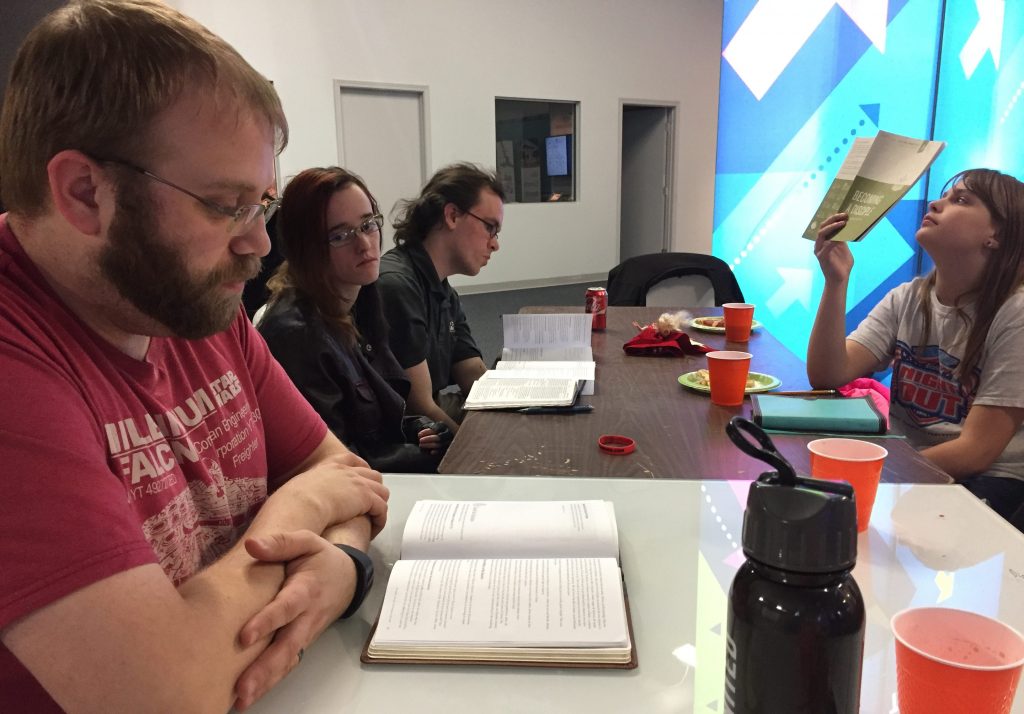
      • We begin our time together sharing a meal and our lives. Entire families, including children, participate.
      • We then move into 4 groups, each following a development track:
          • Becoming a Disciple – BILD Institute
          • Laying Solid Foundations in the Gospel – BILD Institute
          • Acts – Antioch School
          • Habits of the Heart – Antioch School
      • We end by gathering everyone together to pray and discuss upcoming schedules.

“The Church is not like a family, it is a family and I am thankful that it looks like it too!”

There is much work still to do but it has been an exciting process of growth. We are seeing entire families where parents and children each learn the same principles of the faith, while simultaneously discussing these principles with leaders who sharpen their vision and purpose in the city.  Some of these leaders are enrolled in the Antioch School, earning degrees with their work. The church is not like a family, it is a family and I am thankful that it looks like it too!

The Antioch School is an important aspect of our work in reaching our city. It provides a developmental pathway for leaders who need the cultural currency of a degree, but want to learn in the context of their work in the church. This process builds one-mindedness among leaders who seek to reach the city. It is in this context that we can truly begin to see how the church of Jesus Christ can have lasting impacts on our cities.

Sneak Peek: Leadership Development in the First Century

Here is an article written for the forthcoming Encyclopedia of Christian Education, called “Leadership Development in the First Century: Paul” by Stephen Kemp, Academic Dean of the Antioch School.  We thought you might enjoy an early sneak peek.

Leadership development in the first century was a natural part of apostolic work and church life in the progress of the gospel. Paul appointed elders in each church (Acts 14:23, Titus 1:5), wrote letters of instruction to the leaders of churches, and provided models by his presence (e.g. in Ephesus for two years) and the record of his presence (Acts 19:1-20:38). He also sent his young apostolic leaders into substantial places of difficult ministry (e.g. Timothy to Thessalonica, Titus to Crete) and wrote letters of instructions to them.

Leadership development in the first century was development of local churches to sustain an exponential church planting movement. It is best summarized in 2 Timothy 2:2, “The things which you have heard from me in the presence of many witnesses, entrust these to faithful men who will be able to teach others also (NASB).” Local church and apostolic leaders are responsible to perpetuate the apostolic teaching, namely the proclamation about Christ (kerygma) and the corresponding doctrine (didache) about what to believe and how to live accordingly.

All believers are gifted by the Spirit (1 Cor. 12:7). These gifts are to be stewarded for the sake of Christ and therefore need to be developed (Eph. 4:16, Col. 2:19). Gatherings of believers should include edification, stimulation, and growth (Col. 3:16, Heb. 10:24-25). Emerging leaders should “fan into flame the gift of God” (2 Tim. 1:6).

Roles and responsibilities are at the core of Paul’s teaching about leadership development. These can be categorized according to the social concept of household. A distinguishing characteristic of a Christian family is the spiritual development of its members (Eph. 5:21-6:9, Col. 3:18-4:1). The household is also present in Paul’s conception of the church (1 Tim. 3:15), instructions about relationships in the church (1 Tim. 5:1-2, Titus 2:1-10), and qualifications of church leaders overlap significantly with family leadership (1 Tim. 3:1-15, Titus 1:6-9).

Criteria are important in the first century model of leadership development. Overseers are to be “above reproach” (1 Tim. 3:1) and “have a good reputation with outsiders” (1 Tim. 3:7) and deacons likewise (1 Tim. 3:8). Timothy was acknowledge as having been “spoken well of” by the brethren (Acts 16:2). Qualifications of leaders and therefore content of leadership development include family characteristics (e.g. husband of one wife, managing his own family well), personal characteristics (e.g. self-controlled, respectable, hospitable), and ministry characteristics (e.g. able to teach).

The leadership development approach of Paul (with emphasis on organizational structure and the establishment of churches) and the leadership development of Jesus (with emphasis on relationship and the emergence of a new community) should be viewed as complimentary. The Gospels themselves were leadership development tools written by apostles who served alongside Paul (e.g. Luke was a close co-worker with Paul). The Gospels provide leaders and churches with a foundational understanding of Jesus (kerygma), an apologetic for the legitimacy of the apostles, and a connection between the teaching of Jesus and the teaching of the apostles (didache).

Bibliography

  • Bruce, F. F. The Pauline Circle. Grand Rapids: Eerdmans, 1985.
  • Reed, Jeff. “Paul’s Concept of Establishing” in Pauline Epistles: Strategies for
  • Establishing Churches, Ames, IA: BILD International, 2001.
  • Verner, David C. The Household of God: The Social World of the Pastoral EpistlesChico, CA: Scholars Press, 1981. 
  • Zuck, Roy B. Teaching as Paul Taught. Grand Rapids: Baker, 1998.

Put the Seminaries Out of Business?

Guess which seminary president made these comments.

“If a young man has the opportunity to study with a pastor and be right in ministry alongside him all the time, that is going to be better than what you are going to get at any theological seminary anywhere on the planet.”

“Another trend is that more and more pastors are beginning to take responsibility for theological education within the context of their church.”

“My argument is that we need to put the seminaries out of business.”

My hope is that if the Lord lets us operate long enough that we can turn out pastors who will not look to the seminary like we’re the medical school to turn out doctors.”

“Generation after generation of the Christian church has had to develop the ways it trains pastors.  The seminary in the American experience grew out of the effort to emulate other forms of professional education.  And in one sense, that’s the downfall of the entire experiment.  You had debates going back to the nineteenth century as to whether the ministry is a profession and should we should have professional schools alongside the others.  What you have with the emergence of the modern seminary is a school that is intended to train pastors for the church alongside the medical school, dental school, . . ., and all the rest.  That works educationally, but it doesn’t work for the church.”

“Seminaries should not be the places that train pastors.  We should be the places that help churches to train pastors.”

“The transfer of cognitive information is what we do really well.  We have classrooms.  We have books.  We give tests.  We expect papers.  That’s what goes on.  But what goes on in pastors training pastors in the local church is far more important and fundamental.”

“The local church needs to train what only the local church can do.  Pastors are the most effective trainers and educators of pastors.”

“You can’t franchise out theological education.  It belongs to the church of the Lord Jesus Christ.”

These things were said by Al Mohler, President of Southern Baptist Theological Seminary, in an April 2011 Gospel Coalition panel on “Training the Next Generation of Pastors and Other Christian Leaders.”

When I first listened to the panel, especially the comments of Mohler, I kept waiting for them to say that the panel was sponsored by the Antioch School!

In the spirit of honesty and full disclosure, he and others say much more.  Mohler has a particular perspective about the relationship of the seminary and church that still has a vital place for the seminary, particularly Southern.  In the video above, go to 4:58, 11:20, and 27:13 to hear him explain what he means. However, the bottom line as noted above is that he acknowledges the church’s role as “far more important and fundamental.”

In the Antioch School, we take this idea very seriously.  We think much more can be done in the local church than Mohler imagines, including things that he thinks are better done by the seminary, such as “getting that running start in ministry” and even matters of “cognitive transfer.”  The church is the ideal context for guarding the deposit.  The church still is the institution that God created for the purpose of passing on sound doctrine, cultivating ministry skills, and transforming character in an integrated manner.

We are delighted to hear leaders of traditional seminaries acknowledge the unique role of the church in theological education.  And we are even more delighted to be doing something about it by providing the truly church-based Antioch School.

We are not trying to “put the seminaries out of business.”  In fact, we envision seminaries being reinvented as true resource centers for churches and church networks, but in a form that is not dominated by the schooling paradigm.

What we are really trying to do is to “put churches and church leaders in business,” particularly the business of training leaders that God has mandated for them in 2 Timothy 2:2.